

INTRODUCTION
Experts from the government, from the
regulators and from the academia including those from the OP Jindal University
held a deep dive session on “Rethinking Regulators: Strategic Asset for
Business Growth” on 12 June, 2025.
At the intense session, experts
discussed how some of the regulators have made the welcome transition
from just checking boxes to enforce compliance by individual entities to
principle-based regulations. This has allowed the regulators to
develop pricing decisions that suit the industry and serve the
customers. This has helped them move away from being held hostage to managing
the capital investment made by the business as the basis of pricing of services
that helps the sector grow and keep costs low for the customers.
The context is clear. The world has
moved from being governed solely by elected politicians to being governed by
specialized technical experts (regulators) because modern challenges are too
complex for traditional political structures to handle alone.
What are the
challenges?
As one of the speakers put it
succinctly when there is a natural monopoly there is always this risk
of dominance and its misuse. So, the government has to have a regulator for
those sectors.”
On the same theme, another expert
pointed out that to make the transition to the principle-based regulation it is
important to make a judgement call about the quality of regulators.
“This has not always proved to be a very effective example in India's case”,
was the opinion in this context.
Only if these conditions are met can
the regulators be regarded as “strategic assets”. The reverse question is if
they are not strategic assets, then do they become liabilities? It was also
debated that globally there is a tendency to shift away from regulators.
“There's no denying this and one of the most approximate and acceptable reasons
for that is the cost of funding regulators”.
These raise the issue of funding for
the regulator and questions on whether the consumers get to know how much of
the charges she pays as well as the means to finance the regulators.
In this context the announcement made
in Union Budget FY2026 for a relook at the regulators presumably means moving
towards a light touch approach. But then “what exactly is a light touch
approach or the feather touch approach and how those should be balanced, will
be some very interesting issues to develop”.
For instance, some regulators are
examining the nature of investments made by business in the states to figure
out if the money is going into the extraction of minerals or whether they are
going for the development of infrastructure. It is difficult to judge whether
such analysis would be classified as a light touch regulation or an invasive
one. But when the regulator sets charges those have to be reasonable which means
a fair number of details from the sector operators have to be extracted to
arrive at a fair decision.
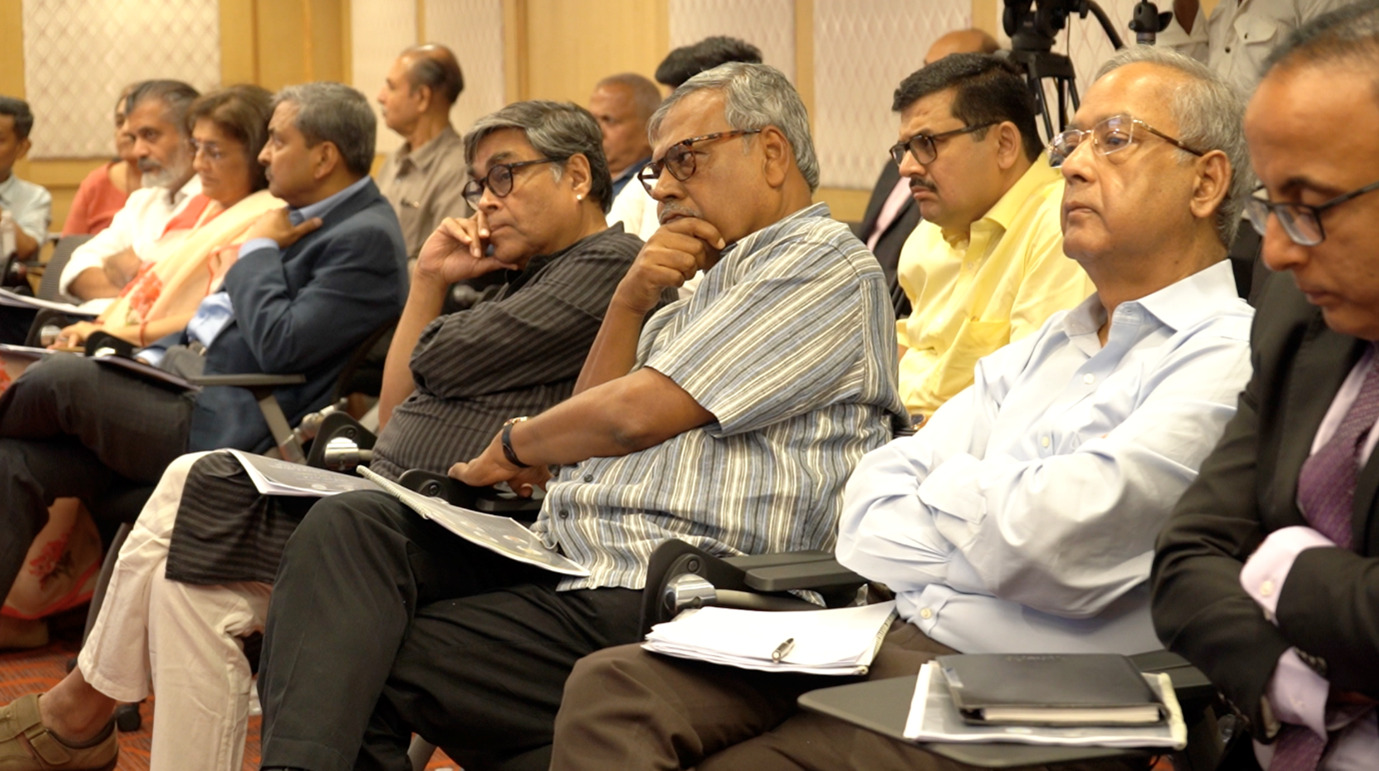
The closed-door session was attended by
over 50 guests and a most distinguished panel of experts. The session
also discussed the aim of CRG, as enunciated by Dr. C Raj Kumar Founding Vice
Chancellor of the Jindal Global University to build an annual report focused on
assessing—rather than criticizing—regulatory bodies. The goal, assembled
scholars acknowledged was to build a deep understanding of regulation that also
becomes useful for policymakers, business leaders, and the public.
Some of the specific themes discussed
were with respect to Insurance Regulatory and Development Authority of India
and Airports Economic Regulatory Authority, among others.
Expanding the market: From forcing
every company to follow the same rigid rules ("one-size-fits-all"),
regulators are moving to principle-based regulation. This focuses on the
outcome rather than just "ticking boxes." Through the means of
Regulatory Impact Assessment (RIA), the regulator could now assess the cost to
businesses before passing any new rule. Simply put if the benefit doesn't
outweigh the cost, the rule isn't made.
Also, IRDAI has moved insurance
products and sales from a "city-centric" model to a
"village-first" approach through state-level strategy where
underwriters partners with state governments. This ensures that money from
insurance is invested back into local projects like roads and mining, helping
the state grow. They are training local "village entrepreneurs” and using
post offices to sell insurance.
Regulating a
monopoly:
Airport, airlines, passengers and cargo
are the four stakeholders in Airport infrastructure sector. Earlier the
state-owned Airport Authority of India (AAI) used to play the dual role of
airport operator and regulator. Thus, it was both fixing aeronautical charges
for airports as well as monitoring performance standards of airports. “So,
there was a mismatch between the charges levied and the quality of service which
was being made available by airport. This was one of the reasons for bringing
private sector to improve efficiency and promote competition.
The perceived benefits are in terms of
savings in government expenditure that can instead be spent on other priority
sectors while private companies handled airport costs. Modernization ensured by
Regulators make it essential for airport management companies secure financial
leeway to upgrade facilities and facilitate growth in terms of business
expansion, offer a modernized public infrastructure and expand the
industry.
For instance, the Delhi Airport in
2006, when it got privatized, had capacity to handle just 12 million
passengers/annum and today it has expanded to 100 million passenger/annum.
In this context the regulator has to
ensure that though an airport is a natural monopoly, passengers and airlines
are not charged unfairly. It can be concluded that having a regulator has been
beneficial for the industry because it has attracted Investment, encouraged
Private Competition and acted as a Strategic Asset.
Quality Of
Regulations:
Ensuring the quality of regulations is
a very subjective idea. To assess that it might even be necessary to bring in
another regulator to examine the regulations.
This means there is a delicate balance
between regulations and regulators in a modern economy. This should cut against
an overriding tendency to create regulators without matching laws. It creates a
risky environment as a regulator without a clear law could end up making rules that
exceed their mandate.
This has happened globally too. While
the WTO struggles as a global regulator as the respective legal environment is
not clear, whereas the Free Trade Agreements (FTAs) often have no central
regulator but succeed. Parties to the Agreement follow a set of agreed-upon
rules based on trust and mutual benefit. Business happens
"seamlessly" because everyone respects the rules, not because a
"policeman" is watching.
Are Regulators
“Strategic Assets”
Regulators operate as strategic assets (tools
that add value) provided they add value. However, if a regulator doesn't
provide clear value, it effectively becomes a liability. Globally, people are
moving away from heavy regulation because it is expensive and difficult to
fund. There is an identity crisis of Regulators. It is important to remember
that they are not industry associations or lobbies, but are government
agencies.
Some smaller states like the
Philippines have specific laws because of which there is no need for a
regulator. If you want to change a rule, you go straight to Parliament. In
these cases, the law is the final word, leaving no room for a separate
regulatory body to interpret things.
Q&A
1. How to ensure
costs do not multiply for the citizens using a service. The answer is that this
is a delicate balancing act designed to protect three main groups while keeping
the industry financially healthy. Business for instance, should recover
investments and earn reasonable return (currently targeted at roughly 15%) but
also provide costs low enough to keep using the facility or buy the services.
2. What is the
Future for Regulators when you see that the world order is kind of bickering
and is almost falling into smaller compartments? It can be related to why era
of massive, global trade agreements (like WTO) is ending and what is replacing
them. WTO was built on the assumption that trade should be a neutral engine for
growth and poverty reduction, originally assuming countries would follow single
set of global rules because everyone benefited economically. However, major
powers now use trade as a tool to project political and economic power
(geo-economics). Powerful nations now prefer to set their own standards.
Since global agreements are failing,
trade rules are moving to smaller, more manageable groups, the EU, for example.
It focuses on keeping its internal trade moving smoothly because it has a
massive "vested interest" in its own neighborhood.
3. While
regulators often control pricing, they frequently overlook customer redress.
The answer is related to the following steps taken by regulators for customer
redressal:
Dedicated Support: A specific call
center, web portal, and set of regulations are devoted entirely to policyholder
grievances.
Transparency: the regulator must
publish data regularly in its annual reports regarding number of complaints,
resolution rates, and companies with the most issues.
Legal Authority: Under Insurance Act,
regulator has power to intervene if justice is not being served.
Board Oversight: Reviewing customer
complaints is mandatory agenda item at board meetings.
Conflict Resolution which means
Simplified Communication: Using media campaigns to explain policy terms and
conditions in "plain English".
4. Whether
independent regulation can survive when line between big business and
government disappears. What was once a theoretical "conflict of
interest" has become a reality in many countries. The core change in 1991
was moving from govt-controlled regulation to independent regulation. 3 major
flaws were identified in current setup:
Regulatory Overlap and Vacuums: There
are now roughly 30 different regulators for economic activities. This creates
two problems: Overlap due to Multiple agencies and Vacuum where agencies claim
it wasn't their responsibility.
Lack of Coordination: While regulators
must be experts, there is no effective mechanism to make them work together.
The FSDC (Financial Stability and Development Council) is meant to do this but
is currently failing to bridge gaps between 30 different bodies.
Accountability Gaps: Regulators are
financially independent, which is good for autonomy but bad for oversight.
The Theory: Their reports are
"tabled" in Parliament for review.
The Reality: In 40 years, there has
been almost no actual discussion or debate in Parliament regarding these
reports. They are filed away without scrutiny.
A persistent issue was acknowledged:
Crony Capitalism. When big businesses are "over-friendly" with the
government, it becomes difficult for regulators to remain truly independent.
There is often confusion over who should speak or act-government or regulator.
5. What are the
main Regulatory challenges in India? The main challenges can be attributed to:
Regulatory Confusion & Policy
Inconsistency
Contradictory Signals: Using the banking
and insurance sector as an example, different government bodies often issue
conflicting circulars
Legal "Escape Clauses": Many
laws governing PSUs have built-in loopholes that allow them to bypass certain
regulations, such as requirement for independent directors.
Shift Focus to "Sub-national"
Level: It is suggested that instead of only looking at global or national
standards, we should look at state and city-level regulation.
Funding and Independence: Self-Funding:
This would make the regulator more independent.
The Licensing Debate: There is a
question of whether the Regulator should also be the one to issue licenses. In
some sectors (like Finance), the regulator handles licensing. In others (like
Telecom), government keeps the licensing power, and regulator only monitors
behavior.
There was a concern about whether one
appellate body can handle multiple regulators. It was argued that it is well
within the capacity of an appellate body to manage various regulatory concerns,
provided it is structured correctly.
6. Role of SROs
(Self-Regulatory Organization) in Regulations. The core argument is that while
SROs are meant to manage industries, they often lead to "regulatory
capture," where a few powerful players (incumbents) lock others out. SROs
are often formed by the biggest companies in a sector. These
"incumbents" can use the SRO to set rules that prevent new, smaller
competitors from entering the market. Regulations should primarily serve the
public interest, not the ease of doing business.
7. How India
manages complexities of multiple regulators, specifically addressing
"overlap" of jurisdictions and whether regulators favour
government-owned entities (PSUs). To this question, it was mentioned that as
economy grows, businesses are increasingly finding themselves governed by
multiple agencies simultaneously. This leads to:
Regulatory Arbitrage: Businesses
"shopping" for the most favorable regulator to avoid stricter rules
elsewhere.
Turf Wars: Conflicts over which agency
has the final authority on a specific issue.
Inefficiency: The lack of a formalized
mechanism to consult during the drafting of regulations leads to avoidable
friction later.
Addressing the
"Pro-Government" Bias:
In response to concerns about
favoritism toward PSUs, it was argued that:
Regulation is Agnostic: In sectors like
Insurance, rules are applied uniformly to both public and private players.
Enforcement Actions: The Competition
Commission of India (CCI) has a track record of penalizing government bodies
and PSUs for violations, asserting that they are not exempt from the law.
Box:
1. Having more
regulators doesn't make a country more successful.
The Proof: South Korea has very few
regulators but is great for business; China has many, but it hasn't solved all
their issues.
The Risk: Too many regulators often
lead to "turf wars" where they care more about their own power than
the public good
2. Instead of
having many small, specialized agencies, governments are moving towards
centralization.
Example: EU now manages major digital
laws directly through its main commission rather than creating new agencies.
This makes rules more consistent and powerful.
3. There is huge
difference between helping competition & helping specific companies:
Pro-Market: Like a fair referee. They
make sure everyone follows the same rules so the best company wins.
Pro-Business: Like a biased coach. The
government picks a "winner" (a National Champion) and helps them
succeed directly, often ignoring the rules.
4. Regulators used
to be the "middlemen" between government and business.
The Change: Governments now act like
businesses, and big businesses act like political powers.
The Result: If the government and a
giant business are working as partners, they don't want a "referee"
(regulator) getting in the way.
Our special thanks
to:
Distinguished Guests
1. Ms. Sangeeta Verma
2. Dr. Laveesh
Bhandari
3. Ms. Neeta Prasad
4. Mr. U. K. Sinha
5. Mr. Sumit Bose
6. Mr. G V Giri
7. Mr. Deepak
Maheshwari
8. Mr. Leela Tarang
Krishna Paladugu
9. Mr. Ajitesh
Mullick
10. Mr. Davinder
Sandhu
11. Dr. Amit Kapoor
12. Mr. Joydeb
Chatterjee
13. Mr. Rajat Banerji
14. Dr. Shubhashis
Gangopadhyay
15. Mr. Shailesh
Gupta
16. Mr. Sanjay Prasad
17. Mr. Alok Yagnik
18. Mr. P. P. Mitra
19. Mr. Chaitanya
Prasad
20. Mr. Hari Sundaram
21. Mr. Akhil Mathur
22. Mr. Sanjeeva
Narayan
23. Mr. Vivek
Raguraman
24. Mr. Arun Nair
25. Mr. Bharat Reddy
26. Mr. Sharat
Chander
_______________
Reference Article - https://crg.jgu.edu.in/events/3
Leave a Reply