

Release of the report “Regulatory Governance: The
Scope”
(Hosted in Mumbai, April 24, 2026)
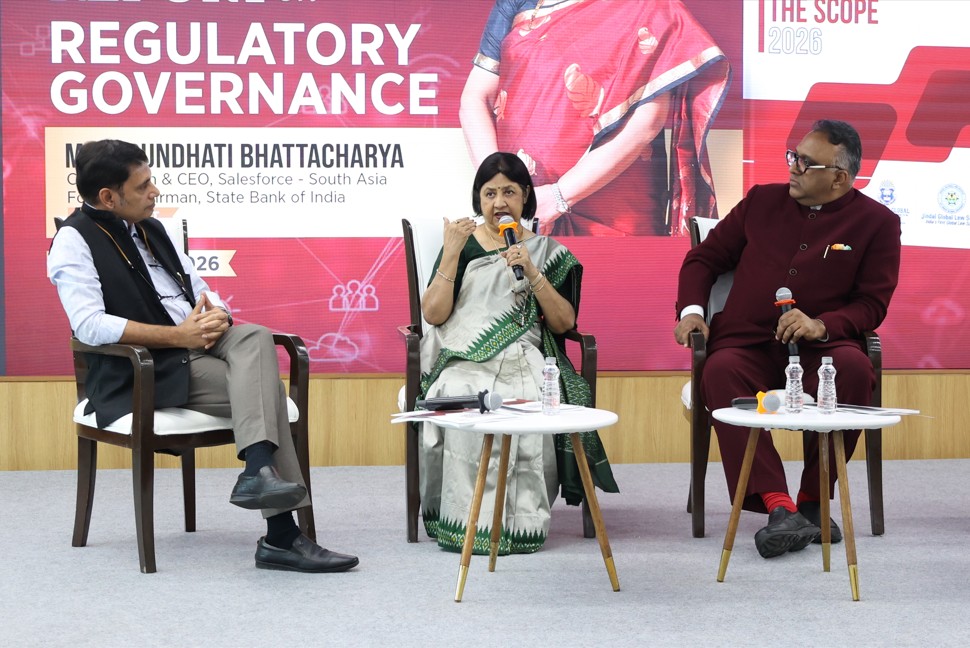
Ms Arundhati Bhattacharya is the Chairperson and
CEO, Salesforce, South Asia, and former Chairman, State Bank of India. In a
chat with Professor (Dr) C. Raj Kumar, Founding Vice Chancellor, O.P. Jindal
Global University and moderated by Professor Subhomoy Bhattacharjee, Director,
Centre for Regulatory Governance, Jindal Global Law School, during the release
of the book by Centre for Regulatory Governance (CRG), she candidly spoke about
how businesses and individuals is that they look for short cuts in their
operations while disregarding the rules set – resulting in Regulators
responding with tighter controls; how Regulators is that they get bogged down
by excessive detailing as execution remains an area of concern, even as
enactment of Rules and regulations remain proper in India. We present below the
detailed conversation.
Q: As a former journalist, there are lots of
questions in my mind for someone who led India’s largest Public Sector Bank –
the SBI, and now, being the president and CEO of Salesforce. Since you have
experience in both the public sector and the private sector, and sit on
multiple corporate boards, where do you think we are in the Regulatory space?
To what extent has India’s regulatory landscape improved? Where does India
stand in terms of Ease of doing business and governance?
A: Different Regulators are in different phases of cycle. Normally I found
regulators are almost always behind the innovation cycle, and rarely ahead of
it. If they are ahead, they become obstacles to innovation. If they fall too
far behind, they create risks for the entire system.
There are certain countries that have the right
balance. Singapore’s Financial regulator, Monetary Authority of Singapore
(MAS), has a Business Development Department—a rarity in the regulatory world.
This department focuses on helping businesses succeed rather than just policing
them. Now, SBI had permission to set up outlets in Singapore. I wanted to set
up an investment banking arm there for SBI capital markets. In India, a bank
cannot also be an investment bank. It has necessarily to be a separate entity.
However, in Singapore, both of these licenses are given together. A bank can
also be an investment bank. In order that the Singaporean operations would
mirror the structure of the Indian parent companies, I requested a second,
separate license, specifically for investment banking from the Business
Development Department of MAS.
They made an exception for the SBI within 3 months
and created a specific license category for SBI, where I could only take an
investment banking license. Now, that is what I call being a true regulator,
where a regulator is not only looking at ensuring that it's keeping the
consumer safe, but it is also ensuring that they are empowering growth. You are
actually being enabled to grow because of the regulations.
There are regulators in every field. For India,
what is needed is growth, because it needs to provide that ecosystem for people
to create businesses, people to create livelihoods. We have got to be all
innovators. But do you have the kind of ecosystem that rewards innovation, that
encourages you to scale fast and fail fast; that you can get up again and go
and try again? That is the kind of environment that is required to be created.
And regulators have a big role to play in all of that. The regulators need to
be nudged to reward innovation rather than stifling it.
Q: It is generally said that we are an
over-regulated and an under-governed country. A lot of effort is made to create
regulations, but that does not automatically translate into good governance.
Now, do you think that's a fair classification? And, when you look at this
entire regulatory landscape from the standpoint of where you are now, do you
see the challenges much more up close than how you saw it when you were in your
previous avatar?
A: I think what you were saying is very correct. What happens in India,
maybe this is true for all countries - if there is a shortcut that can be
taken, people have a tendency of taking it. Now, what do regulators do? They
try to create regulations that make sure that you can't take any shortcuts. As
a result, they begin to create regulation that is not macro in its reach, but
very micro. And when you make the micro-regulation, you literally tie
yourselves and the business up in knots. So, while we definitely seem to be
over-regulated, where we lack is in the execution of those regulations.
As an example, there are a high number of cases
where SEBI orders have been overturned by SAT. What SEBI does is a
quasi-judicial process. They go as per regulations and they give these orders.
It focuses on the spirit and purpose of the regulations to track unfair
practices.
What SAT does is a pure judicial process. So, if
some specific action is not explicitly forbidden in writing, they will rule it
out. Thus, they go by the letter of the law, not by the spirit of the law. Now,
if SEBI wants to write regulations covering every possible aspect of abuse, so
that there is no abuse of law itself, the regulation invariably will become
very complex and very difficult to adhere to.
Instead, what needs to be done, as is done in many
other countries is, whatever is the regulation, you try to make sure that the
regulated entity has gone not only by the letter of the regulation, but also
the spirit, and you act on it at the very earliest.
Matters that take 10 years to be settled here,
generally are resolved within 4-5 months in the US. The fact is, we lack in our
ability to execute, not in the ability to enact. The enactment of the
regulation of the laws is all perfect. Where we fall down is in the execution
of the same. Unless and until we improve there, it's going to be very difficult
because regulation invariably will then have to address a lot of micro issues.
Q: An institution like the SBI prioritizes social
equity and the democratization of financial access—essential goals for India’s
development. But the aspirations of the private sector may not be like that.
So, if you have to create a regulatory architecture for both the public and the
private sector, what are the key aspects that a lawmaker or a policymaker need
to keep in mind so that we don't end up creating conflicting regulatory
imbalances with different aspirations to get fulfilled?
A: SBI was created by an act of Parliament to bring banking to the unbanked
population - to the deep reaches of the country. When Jan Dhan Yojana was
launched, we at SBI, had no doubts about participating in it. It was still
costing us ~Rs. 260 to open each account. Now, that is not a small sum of
money, if you compare it with the number of accounts we had to open - which was
one per family, right across India. Our coverage till that point of time was
~58%. When we ended, the coverage was 98.7% of the population. 33% of those
accounts were opened by SBI. The initiative was so successful that even the US
was impressed, and the Board of FDIC asked me to come over and address them as
to how we had got it done.
Now, coming to the private sector, they mention
they have to report their results to the shareholders and they cannot run
unprofitable operations that affect their stock prices adversely. They say I
will wait for you to become viable with these accounts. Then, we will step in.
So, they have no problem taking these on as customers as long as they are
viable.
Thus, to ensure participation from both the
sectors, initiative should be financially viable. If you don't make it
sustainable for them, then you'll have to do it by fiat, i.e., by government
order. Now, in this case, some will comply out of duty and others out of legal
obligation. But innovation stalls - as they are acting out of obligation rather
than interest. To encourage proactive engagement, we must differentiate between
reasonable profit-making and profiteering. Regulation should prevent the
latter, but allow reasonable profit. An operation will not be sustainable if it
is not profitable.
The government created an open, free public stack
of digital tools. People got these accounts, 97% of which were zero balance at
the point of time of opening. Now, a lot of them started getting the direct benefit
transfer. Previously, due to middlemen, the actual beneficiary was getting very
less. A former finance minister had said that of every rupee of subsidy that we
give to the below poverty line family, only 13 paisa actually get to them. Now,
that 13 paisa suddenly became a whole rupee going to them.
The UPI platform was built free by the government
and invited the private sector (GPay, WhatsApp Pay, etc.) to build apps on top
of it. Everything started running on that platform. But the backing behind that,
are those accounts that we opened at that point of time. What happened as a
result was that the informal economy, that was in cash, started getting
formalized because everybody was paying with a QR code. Now, the moment it gets
into a QR code, the cash starts flowing up in your bank account. And if you
have a cash flow in your bank account, and in a month, you're making Rs
5000/-, you become eligible for a Rs 500/- loan. That loan, if taken from a
money lender would have been availed at the rate of 10% per month. Now, you
start getting it at 6% per annum. Imagine the difference it can make in the
lives of these small people.
And that is how inclusion has worked in India. If
you look at the tax ratios today, that has gone up, on account of formalization
of the economy. The number of people who are accessing the formal financial
system has gone up exponentially. And the lives of people, their standard of
living has definitely gone up on account of the fact that this financial
inclusion has taken place. So, India basically is growing from the bottom on
account of all of this.
Again, has regulation played a part over there?
Definitely. Has government fiat played a part over there? Definitely. Can we do
better if we bring about the public-private partnership? 100%.
Look at DigiYatra today. DigiYatra is a
public-private partnership. How much easier has it made your life? Where you
can just walk in because your face is your identity. It's made life so much
easier. So, there is a lot we can do to come up to potential. But regulators
and government both have to be aware of the fact that it's good to have
private-public partnership.
Q: Almost 5.5 crore cases are pending in Indian
courts, which is a significant challenge we are facing. Over the last several
decades, we created many regulatory bodies to reduce the burden of the courts.
But the regulatory bodies are currently hollowed out by unfilled vacancies,
leading to their own massive pendency. Again, appeals from the decisions of the
regulatory bodies are coming back to courts and they're clogging the court
system as well. Do you think that we have made a mess of the regulatory reform
that we ought to have created better?
A: The present legal system often turns the entire
process itself into a punishment. That affects the guilty and the innocent
alike. There are lots and lots of innocent people where the process is also
punishing them for no fault of theirs. To combat this, some youngsters are
looking at how to circumvent this issue and come up with solutions like
launching private arbitration boards to bypass the slow-moving courts.
What
the arbitration board does is, it onboards, say, one large company; and then
onboards all of their dealers and suppliers, i.e., those, who probably have
some kind of friction with the bill payer or the receiver of money. They decide
within themselves that for arbitration, they will come to a particular body.
The concerned body employs a number of ex-judges, ex-regulators and specialists
in those particular industries. All parties agree that they will abide by
whatever award is given by the arbitrator. This has not only prevented a lot of
these cases landing up in court, but also made the process fast. Unlike
traditional courts, these boards provide hand-holding to identify why a dispute
happened. Fixing the underlying issues ensures that the same mistake isn't
repeated elsewhere in the supply chain - effectively reducing the overall
caseload.
I
don't know when judicial reform will happen. There are some structural
limitations as the Chief Justice is appointed based on seniority. Their tenure
is thus often unpredictable – from 60 days to 2 years. As reforms are
deep-rooted, they need a person to be at the helm for longer than 2 years - at
least 4 to 5 years, in order to bring about deep-seated reforms. That rarely
happens. Therefore, you cannot really blame them either, as they don't have the
time in order to bring in these reforms. I think this is one of the weak areas
we have. We need to have other bodies that will arbitrate and maybe, by that
manner, we can reduce the load of the courts by ensuring that all the smaller
matters get taken over by the arbitrating boards.
Q: Does the reliance on former judges, lawyers and
government officials in the alternative dispute resolution mechanisms in India
limit its success as they tend to carry over the same procedural habits and
mindsets from the earlier legal system? Has it also adversely impacted the
potential for regulatory bodies playing a more positive and facilitative role?
And should we consider bringing in private sector expertise to be part of
regulatory bodies as members?
A: Different regulators have behaved differently. It is important not to
generalize it. Some have performed excellently on account of the kind of
working style that they have brought with them. Some have not been so. While it
is debatable whether bringing in people with more industry expertise is needed,
such expertise must be balanced with a fundamental understanding of mediation.
Creating newer structures may not always be the answer. What we need is better
infrastructure, better usage of the newer tools. For e.g., Artificial
Intelligence. Although AI may have inherent biases, it has the ability to
analyze a case study in seconds. So, we need to look at the newer tools to see
whether we can do better within the framework that is already there and focus
on empowering our current arbitration and judicial frameworks. I
think that is where we need to sort of focus on, rather than create more and
more bodies. Because if the basic stuff doesn't change, the addition of more
bodies will only create a higher number of backlogs.
Q: Unlike the private sector, regulatory bodies
have much less emphasis on training and capacity-building programs, targeted
for them, looking at the best practices of regulators around the world. Can we
improve the quality of domestic governance by understanding international
best-practice training for regulators?
A: I haven't interacted very closely with regulators other than RBI and
SEBI. They do have their own training institutions and also have people going
abroad on deputations in order to understand how other countries work. They
attend a lot of conferences where regulators from across the world come in
order to have proper interactions and understanding of what is happening where.
I am not too sure about other regulators whether they have these training
institutions. But given the pace of evolution that is going on in the world
today, a lack of exposure to new tools and business models is a significant
handicap. So, it is definitely up to the particular regulator to ensure that
they are being able to access the right kinds of training, conferences and interactions,
in order to ensure that they are up to date. If we are not a constant learner,
we soon become irrelevant.
Q: During the merger of so many Banks in SBI,
having a huge number of people, what was the big HR-related issue that you
faced?
A: The biggest challenge was always the HR. Technology allowed me to
address everybody by name and send them out letters.
First of all, I sent letters not only to the people
that we were merging into us, but also to our people – addressing the fear of
involuntary, nationwide transfers. I clarified that we had no intention of
uprooting staff unnecessarily. We established a "clearing house" for
voluntary transfers. This system helped us to relocate employees who had been
stationed far from home—like those from the Northeast serving in Kerala—back to
their preferred regions. So, having a pan-India presence helped us in
positioning ourselves as giving them an opportunity for better placement,
transforming a source of anxiety into a significant employee benefit.
Second, came the issue of promotions. The people in
my parent organization felt that they were going to be challenged for
promotions. We tried to address it by telling them that the organization had
grown bigger, resulting in an increasing number of seats. Thus, it is up to
them to prove their merit in order to get one of those seats. Our means of
communication was direct engagement and putting up a grievance portal to answer
their queries within 24 hours. We assigned Deputy Managing Directors as mentors
to specific institutions. They went around wherever these banks were there in
large numbers - ensuring high-level oversight and guidance. We hosted town
halls in regions with high employee concentrations to reassure staff and
provide transparent answers. Due to differing interfaces, we had to do a lot of
training to familiarize incoming staff with our systems and platforms.
Q: Looking at bodies like the Competition
Commission or the National Green Tribunal, which have lawyers, economists,
scientists, environmental scientists, in addition to judges and lawyers, how
essential is multidisciplinary expertise versus a purely legalistic approach
for modern regulatory bodies ?
A: I think a multidisciplinary approach is very much required both for
regulatory bodies as well as for companies. If you don't have that
multidisciplinary approach, then you don't get the full picture. Tech experts
are essential as technology now serves as the backbone of all operations.
Similarly, dedicated HR specialists are vital; it is what drives the quality of
the stuff that is coming out of your company. And talent that is good also
needs to be nurtured.
Leave a Reply