Newsletter November 2026
Dear Friends,
The Centre for Regulatory Governance (CRG) at the Jindal Global Law
School in O.P. Jindal Global University (JGU).
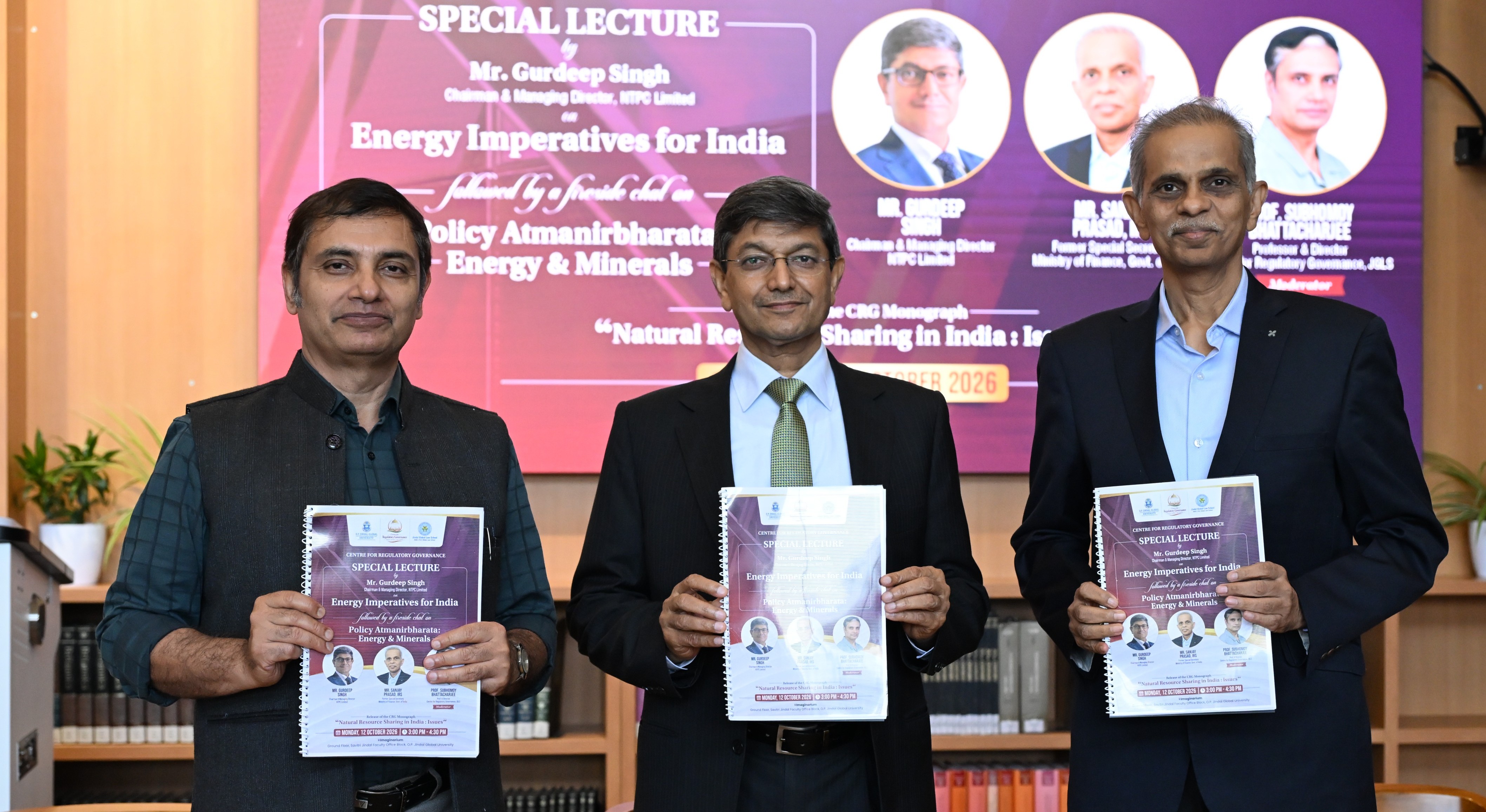
We recently played host to a conversation between the chief of India’s
largest electricity generation company, NTPC and a top official from India’s
Finance Ministry. Is India generating electricity and pricing it competitively?
A summary of that conversation between Mr Gurdeep Singh and Mr Sanjay Prasad is
here.
We could not have imagined how prescient the topic would be when just
days later, the Haryana government walked back on a model to offer electricity
through competition, delivered to the consumers’ meter. The issue was simple.
The Electricity Act, 2003 had offered consumers the right to choose their
electricity suppliers just as they choose their telecom service provider.
States and even the central government have worked for 24 years to block this
reform. Results, while India has 559 GW of installed capacity and the total
demand has never exceeded 280 GW, there are no consumers who pay a fair price
for the power they consume even if they wish to.
That promise was made effective when the Haryana State Electricity
Regulatory Commission ordered, in October, the entry of Eleven Power Producer
Limited as a competitor to the sole power supplier for Southern Haryana, the
government-run Dakshin Haryana Bijli Vitaran Nigam Ltd. The cities covered by
the new order were Gurugram and Nuh. The Haryana government has issued a policy
directive, a rarely used powerful tool to block the order.
There was certainly a question mark over why the new entrant would wish
to take on electricity distribution, unless it had got an approval to use the
existing supply lines to send its own electrons to homes in these two towns.
Otherwise, as Somit Dasgupta, former Member, (Economic and Commercial) at the
Central Electricity Authority points out in this piece, “To recover this investment, the new
licensee will have to levy a heavy fixed cost which may lead to a tariff higher
than what the consumers are already paying. Then why should consumers move away
from the existing licensee unless, of course, the new licensee can manage to
get power so cheap that savings in energy cost will outweigh the high fixed
cost. This can perhaps be possible if the new licensee can tie up solar power
of the required magnitude. However, no distribution utility can run only on
renewable power”. There is a bill in Parliament that would allow the challenger
the option of using the existing trunk infrastructure, but that is
prospective. Clearly, questions!
Before these could be settled, however, the Haryana government has
ensured a first-class legal battle to be waged for years at various forums.
The Haryana case shows how states are getting into regulatory tangles
with these authorities. As the Business Standard reported, the Maharashtra
government has moved the Bombay High Court challenging the constitutional
validity of certain rules and orders issued by the Food Safety and Standards
Authority of India, FSSAI. The report notes “The state has
accused the central regulator of creating a parallel enforcement system and
encroaching on the powers of state food safety authorities”.
The reasons are obvious. Food, electricity, health, et al are domains
where the states feel the need to keep a sharp eye. Data and education could be
the next. As regulators begin interceding in these sectors, the possibility of
a rift between elected state governments and citizens has risen.
How should the citizens respond? Evidently, regulators issue orders
keeping in view the broader interests of all citizens. This will naturally
bring several interest groups into a clash with these aims. These groups find
the state a useful ally in the battle. In Haryana for instance, Gurugram
residents would have found the competition a great Diwali gift, the employees
of the incumbent power distribution company didn’t think so. In Maharashtra the
state is contesting segments of the FSSAI Act of 2006. The law had authorised
the FSSAI to lay down science-based standards for food products and regulate
their manufacture, storage, distribution, sale and import. The central point of
the dispute is does the state or does the centre have the right to inspect food
safety. Consumers of sweets or other food stuff are not bothered who does the
work, they would only insist it be done effectively. The state petitions in
both cases argue on behalf of the citizens but are meant to preserve the turfs
of influential segments.
These will become the new fields for regulators to tread carefully. As
the Centre cedes more space to the regulators who, by definition, are
technically qualified to decide, the states will often not agree.
Some even larger issues will be covered by CRG later this month when Mr
David W. Russell, CEO of Russell Communications, Tokyo speaks with Dr
Shashi Tharoor, MP and Chairperson of the Parliamentary Committee on
External Affairs, Mr Amitabh Kant, former IAS and former CEO of Niti
Aayog and Prof (Dr) C Raj Kumar, Founding Vice Chancellor, JGU. The
theme is What do nations need to do long-term to survive? “The Long Game”
promises to be a fascinating conversation where we sincerely hope you will join
us.
Meanwhile, there are a whole lot of other issues that we covered in
our monthly round-ups. I invite you to read or preserve them as ready reckoners
for your work.
With Regards
Subhomoy Bhattacharjee
Meanwhile,
major reforms persisted in the Indian Regulatory space. October, 2026 witnessed
major upheaval in the stock market – especially, as stocks of Banks, NBFCs and
Insurance distribution Companies reacted negatively to the draft rules
initiated by IRDAI. Power sector too was in the limelight that saw draft rules
by the CERC and concerns over India’s Data Centre boom sparking grid stability
concerns. Focus shifted to the Indian pharmaceutical sector on concerns over
overcharging of medicines in India, with another discussion on the harm that
could be caused by India’s over-dependency in few critical sectors on the international
markets.
IRDAI: Since Dec 2025 when the 100% FDI Bill was passed in
the Lok Sabha, the Insurance Regulatory Institution has not looked back at
reforms. The recent Draft Bill caused a major shock to the Banks, NBFCs and the
Insurance distribution Companies in particular, though the Institution says it
will benefit the customers by reducing cost – resulting in higher penetration
of Insurance products. The panel discussion at the CRG Monday Regulatory Table featuring experts,
faculty and students deliberated on the implications of this draft bill,
debating whether the proposed reforms will genuinely expand coverage and lower
consumer costs or inadvertently disrupt the financial and distribution
ecosystem.
CERC: The Central Electricity Regulatory Commission (CERC) Draft Regulations
2026, too brought about crucial reforms to accelerate trial
operations and commercial commissioning for renewable energy (RE) and Battery
Energy Storage Systems (BESS).
CEA: The rapid growth of
Data Centres has forced the Central Electricity Authority (CEA) of India to initiate
a study to assess the rapid growth of data
centers and their impact on power grid stability. The committee will
analyze data center electricity load patterns and examine whether separate
regulatory classifications or guidelines are necessary to manage their rising
energy demand.
CCI: In a commentary written
by our university student, it analyzes how unfair platform fees, coercive data
sharing, and self-preferencing by dominant digital gatekeepers threaten the
survival of Indian start-ups. It also suggests ways as to how the Competition
Commission of India (CCI) can regulate
dominant digital platforms (like Apple, WhatsApp, and Google).
The detailed reports and discussions by our CRG panelists
analyzing the reports are captured in our website: https://crg.jgu.edu.in/.


.jpg)