

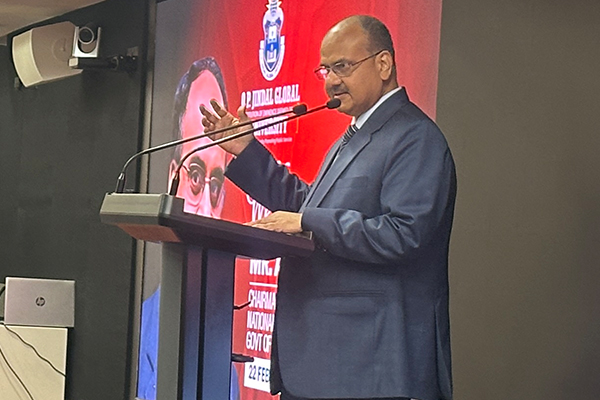
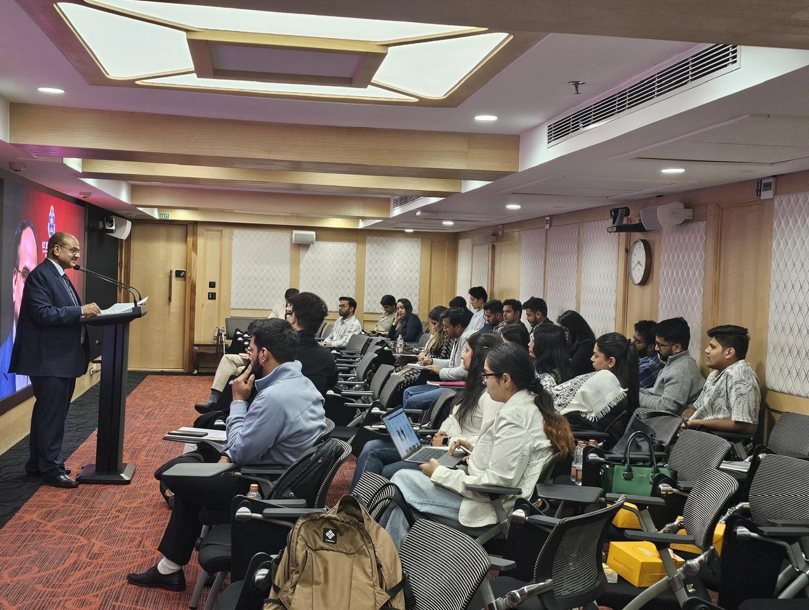
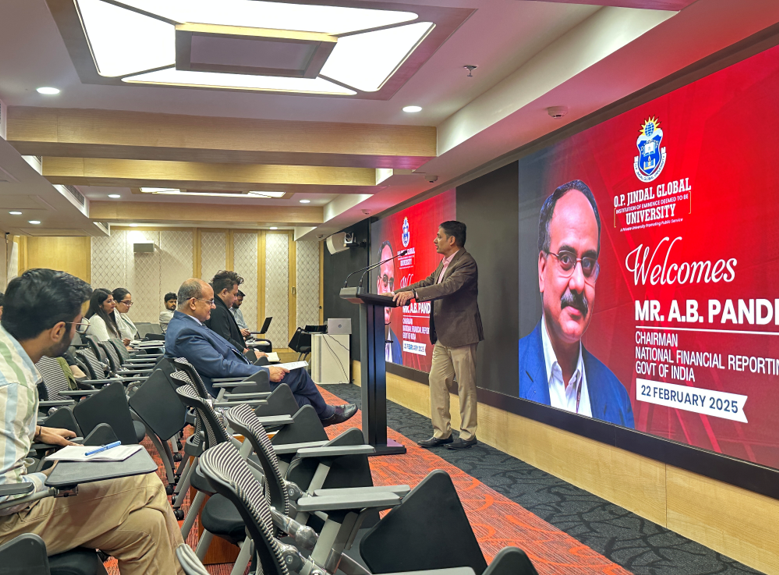
I'll give you a little bit of background, the perspective of our work at the NFRA, and why it is so critical for our country at this stage of development.
So let me give you some of the figures.
We are trying to grow at the rate of 8% GDP in the real terms. We are already
the fifth largest economy in the world. And we aspire to become the third
largest economy very soon. Now, the IMF estimates that by next decade, India
will contribute almost 20% to the global economy. By 2031, India will be a $ 7
trillion economy.
In the process our per capita income,
which is around $2,500 now will double. We shall be a middle income
country. But more than that, where do we reach by 2047. By the time we complete
100 years of Independence by then, there are varying estimates saying that if
we continue to grow at around 8% in real terms, then our GDP, which is about
$3.5 trillion, will become somewhere around $27 trillion. And let us consider
this in the perspective that today's US economy is of this size, $27 trillion.
But China is $17 trillion. Of course, by 2047, they also would have gone much
ahead.
Our per capita income will be around
$14,000 to $15,000. So that will become a middle income country. But then, is
just a kind of a hope? Or is it just something that it will just automatically
come? In fact, recently Bain Consulting came out with a report. It was very
interesting. What they have done, they have said that supposing what happens if
India continues to grow at 5%, then what will be the size of our economy in 2047?
It will just be $13 trillion. Very, very far away from $27 trillion, right?
What makes a high
growth rate happen?
So we must grow at around 8%. Now, how
will this happen? It will require a lot of private investment. It's not the
responsibility of the government alone. For instance, the government's budget
today is around Rs 50 trillion. But our GDP is around Rs 260 trillion, right?
So government investment alone is not going to drive the GDP. So this means we
actually require a lot of private investments. And what we are finding is that,
who are the investors? And why would they invest in companies?
Remember, the investors, when we were
growing up, the investors used to be large, big industrialists. Only they used
to invest. Like the Tatas, Birlas, Dalmiyas, these are the people who were
investing.
Instead during the last 10, 15, 20
years there is now a kind of a democratization of investors. One of these is
the startups. To finance them are the retail investors, who through the SIP are
putting in money. And to make all this happen seamlessly, we are quite
fortunate that an entire digital revolution has taken place in India,
particularly in the financial sector.
And I feel very fortunate that I have
been associated with many of these things, like Aadhaar, for example. That
actually solved the problem. It is unique. Nowhere in the world do you have
this. You can do your KYC online. You can open a bank account. You can open a
DMAT account, and so on and so forth. All those things are possible today. And
that actually has led to the democratization of investments.
For the retail investors these have
simplified investments. Everyone says, let me put some money. Let me have some
SIP.
Then, a lot of foreign FIIs, foreign
investors, FDIs, plus domestic institutional investors, all of them are coming
here. And that is where the role of corporate governance, which I was
mentioning in the beginning, that becomes very important.
Because along with good corporate
governance comes trust. People should be able to trust the management, trust
the board. And that is what is very, very critical.
I remember that in 2018-19, one of the
banks called Punjab and Maharashtra Cooperative Bank failed. DHFL, Yes Bank,
and now this New India Cooperative Bank. So whenever such failure takes place,
the people become very wary, saying that, look, should I put my money there?
Will I get my money back? The same thing happens with the companies.
In Yes Bank, the ATI Bonds got written
off, about 12,000 crore rupees, even though Yes Bank was revived. But then the
people didn't get the money, because the nature of the bonds was like that. So
maybe legally it was correct. You all are LLM students. You will know the
process well.
It has had repercussions in the bond
market reducing the level of confidence. Once the confidence dips the people go
back to buying the same things like land or other forms of real estate.
These investments are not that
productive. And then finally, people will say that, all right, I'll put money
in the gold, or I'll keep cash. Now, if that is the tendency, then, , where
will the investment take place? And so therefore, it is absolutely necessary
that if India has to grow, it has to have this corporate governance and trust.
So it is, , I was mentioning about the
rise of retail investors. Some of the figures, what has happened in this wake
of digitalization, , the total amount of DMAT, number of DMAT accounts, was 4
crores just about five years back. Can you imagine how much, how many will it
be? It is somewhere around, , 17 crores.
Now imagine 4 crores to 17 crores in
the span of five years. Then look at the mutual fund portfolio where the asset
under management, used to be 10 lakh crore in 2014. Now it is 67 lakh crores.
The SIP used to be 8,000 crores every
month. Now it is 24,000 crore every month. The small-town people, they are
investing largely 75% of the equity.
And in the big town, about 50% equity.
So why I'm saying all these figures is that corporate governance is no more a
problem of, , let's say, imagine 30 years, 40 years back. If a company failed,
who would have impacted? Because at that time, , the rich and other people, ,
they were investing.
But now it has become a much wider
problem, right? The people from even low income group who have put their
lifelong savings into these are affected. So it is a much bigger problem. And
therefore, the corporate governance and trust becomes absolutely critical.
You'll find that people in your own
family, your uncle, your parents, , they have put their money into many of
these areas, either in the bond or the equity or in the fixed deposit
somewhere.
So that is why it is absolutely
necessary. And if we want that to have a sound investment, people all over the
world, including the domestic investor, if they continue to invest, then they
should be able to trust.
How to improve Trust
How do you create the trust? Because
there is a company. The company publishes annual reports and quarterly result.
But how do that those figures are correct? And you are not aware that the
Companies Act requires, there are certain requirements.
And the accounts have to be published.
And then there are LODR mandated by Sebi. So all those requirements are there.
But who is certifying that the accounts
are true and fair, in the technical terms, that the accounts are true and fair?
First of all, it is the management’s responsibility. And then that of the
shareholders, they actually appoint the tatutory auditor.
Because the accounts are so complex
that it is not for each of the investors to figure out how do you recognize the
revenue, how much is the profit, how much is the loss, how much is the items in
the balance sheet, how much is the assets. So these things are not possible for
everyone to realize that. So they want some kind of an assurance from an expert
body.
And that is what the statutory auditor
is supposed to do. The law also recognizes that, OK, look, there could be a
conflict between the management. Because management would like to overstate,
paint a rosy picture. But then the shareholders' interest is to protect its own
interests. So the law requires that the shareholder has to actually appoint the
statutory auditor.
So a statutory auditor is appointed.
And then the statutory auditors are supposed to audit independently. And then
they have to certify that the accounts are true and fair.
Now, does that happen? You mentioned
about Satyam. Satyam had all these distinguished persons in their board. But it
still happened.
If you look at Yes Bank, you look at
DHFL, all of them had some eminent people. In ILFS there were eminent people.
And top notch auditors.
But how does corporate malfeasance
still happen? You have eminent people on the board, knowledgeable people.
Eminent auditors there. But still, off and on, every five, seven years, some
big corporate failure happens. And then, this completely shakes the confidence
of investors in this entire capital market. Why does this happen?
If you examine many of the episodes of
corporate mis-governance in the world, we find people hid their identities.
This is not possible with a system like Aadhaar. So people would change the
name, add qualification, and all kinds of things happened.
Fake inventory, fake revenue, fake
sales. And this is how many episodes went. And these would be audited by the
Big Four. What I'm saying is, even the good auditors, they also, sometimes, ,
they fail, right? So that is why, so that happened. So after seven, eight
years, around somewhere around 38, 39, , this whole scam broke. And that time,
then suddenly, what went wrong? Then, , the law was incorporated, that you have
to publish your financial statement.
In your board, you should have some
independent director. And then the shareholder has to approve the auditor. And
also, the inventory has to be physically verified by the auditor.
So some of these things came. So
independent person, independent director, , again, for the corporate
governance. So these are some of the things that happened.
Then, , thereafter, then, again, after,
off and on, , the scams used to take place, like WorldCom, then Enron, in our
country, Satyam. So it keeps happening. And finally, in around 2000, 2002,
2003, when Enron things came up, that time, again, thinking was, after all, who
is certifying true and true, true and fair? The auditor.
Who is regulating them? And they said
that, , earlier, the impression used to be, it's a profession. So therefore,
naturally, every profession says that I should be self-regulated, like doctors,
or even the lawyer, for example, right? So the auditor, in case of an auditor,
but then it was felt that, see, the auditor is not only a profession. You are actually
performing a very important public function.
And therefore, is self-regulation
sufficient. And then Sarbanes and Oxley Act came in the US. And then they said
that, no, we'll move from self-regulation to an independent regulation.
And PCAOB was set up in the US. And
then the other countries followed the FRC in Canada, and so on and so forth.
And then, India, we were kind of behind.
And then, , the Satyam came. Then,
2013, this New Companies Act came. And then, New Companies Act, , the
provisions for this NFRA, National Financial Reporting Authority, was there.
But again, even after the, I'm just
imagining that even after, let's say, the parliament has passed and said that
there shall be an NFRA, Section 132 of Companies Act, the entire Companies Act has
more than 450 sections. But only one section was not notified. And you all are
background of law.
Even if the law is passed by the
parliament, unless and until it is notified by the government, that doesn't
take effect. So out of all more than 400 sections, this one section was not
notified. Therefore, even after the parliament has passed, , this NFRA, that
provision was put on hold.
Then about 2017, our prime minister
went to one of the functions of the chartered accountant and spoke his mind.
And then thereafter, 17, 18, a lot of these scams came up, right? Like ILFS,
and many of these things came, Punjab National Bank, for example. Because what
people were wondering, saying that if all these bad things were happening
within the company, then why it didn't come to notice at all? Because they all
had very, very eminent people.
And then the eminent audit firm, then
why it was not being pointed out? So then it was realized that, look, because
no scam can happen, no big things can happen overnight. It slowly builds up
over the years, four, five, six years. So what would have happened, let's say,
in the first year itself, or second year itself? , these things were pointed
out.
And if they were pointed out, maybe in
ILFS, 70, 80,000 people had to lose. They had to take a haircut, bankruptcy, or
maybe just bank, or maybe DHFL. So the retail, as well as the institutional
investor, or the banks, wouldn't have had to take so much of losses.
This wouldn't have happened. The whole
idea was that, why it's not being pointed out? And that is where it was thought
that in India also, we want an independent regulation for the auditor side. And
that is how this, that's the genesis of the NFRA.
Now, if the, so essentially, when we
talk about the corporate governance, I say that there are five lines of
defense. And the five lines of defense, one is, of course, the management.
Because the primary responsibility to prepare accounts and present it to the
server is of the management.
The CFO, the CEO, is there. Then the
second line of defense is of the audit committee, and then the board. Third
line of defense is the auditors.
So what we have seen is, and auditors,
and then the fourth line of defense is the shareholders. So in all these
failures, corporate failures, whether in India or abroad, all these four lines
of defense have failed. The four lines of defense in the sense that the
management pointed out, didn't bring out true and fair.
Then audit committee didn't look into
this. Independent directors didn't look into this. Failed, or it escaped their
notice.
Then the statutory auditor also didn't
point them out. And then shareholders also, because if the statutory auditor
doesn't point them out, how will the shareholders know? So all four, there was
a failure. And that is why, finally, when it becomes public, then everybody
comes to know.
So these are the four lines of defense.
And now the fifth line of defense has been added, that is, of the regulator
like us or SEBI. So we are working on the auditor side.
SEBI works on the company side, board
of directors side. So this is the fifth line of defense. So in order to ensure,
because many times I hear that the people try to pass bucks, saying that, look,
is it our responsibility? Because any failure takes place, then the people
start playing ping pong, saying that you are responsible.
I'm not responsible. But actually,
everyone is in the lines of defense. Tomorrow we are going to also be held responsible
if there is a major something in the queue.
What did happen as a regulator? So
therefore, it is absolutely critical that all five lines of defense should
work. These five lines of defense, in order that five lines of defense work,
then of course, and that is where the role and how we have started working and
what we have found, some of the things, because I must say that the NFRA has
been very, very, that we're a very new organization. We were set up in late
2018, then two, three years, COVID.
And we actually started working in the
real sense from 2021, 22 onwards, so around three years. In three years, we
have passed around 100 orders. Each of our orders is published on our website.
And the reason for publishing in the
website is, of course, to know everyone, that this is what is happening. We
also publish in the order itself one or two-page summary, exclusive summary. So
I think it will be a good reading for all of you.
I will recommend that you must read and
see that what exactly has failed. Where exactly the management or this, they
failed. So you will get an idea.
For example, many of these cases, Cafe
Coffee Day, this is one example. This company, I told that in India, it kind of
almost revolutionized the way the people have. Because earlier, when we were
growing up, and supposing if you wanted to meet some people, some friends were
coming home, where do you go? I mean, you wouldn't go to some, and have a cup
of tea or coffee.
The only place that you will assemble
is in some chowdah or somewhere on the roadside for the tea. That's why, in
your muhalla or somewhere. Because if you go to a five-star hotel, then 500
rupees, something like that.
So the Cafe Coffee Day on the
Starbucks, the kind of format, they started this. And they're supposed to do
very well. But what happened? And we investigated that case, and it is
published on our website.
3,500 crores of rupees. So one is the
listed company. So our domain is only the listed company.
3,500 crores, and then eight or nine
subsidiaries were formed. Those subsidiaries were not the listed companies. So
3,500 crores in some company, 200, 300 crores were diverted.
Either for showing some purchase or
advance or something. From there, entire money went to a private account. A
company, private company, where the 99% share was held by the father of the
main promoter of Cafe Coffee Day.
And from there, the money disappeared.
So we questioned, what were all these auditors doing? 3,500 crores rupees taken
away. And then afterwards, the companies don't have personal money.
It is the people's money, investors'
money, the bank's money, everything. So you find this consistent pattern. Same
thing happened in the reliance capital.
Again, the orders are there publicly
available. Reliance capital, the people put the many of these state public
sector undertaking, they have appropriate fund money. So they need to invest.
And they get a little more interest. So
they purchase their bonds. And because they were AAA, and then, again, the
money got transferred to the various.And do you know the number of
subsidiaries? 200 subsidiaries. And then, the money gets routed so that it
becomes a complicated maze.
That it's not easy for anyone to find
out. And that is exactly what the auditors are supposed to be doing. So, when
we look at recent cases in Indias they often seem a rerun of older cases,
globally. There is no difference.
So, even if 100 years have passed, the
modus operandi remains the same. So, is that a good thing or bad thing? The
Good thing is that, we know the modus operandi.
Right? A bad thing is that, our entire
system has not been able to prevent that. So, I say that, the people always
find new ways of, committing offenses. But here, they have not even graduated
to the new ways. And therefore, I say that, the good thing is that, they are
sticking to the old, and therefore, it is very easy to control. And this is
exactly what we have started.
And in a little bit while, I'll tell
you what we are doing to stamp these out. One example is Cafe Coffee Day. There
were many branches of the company which were non-existent. Now, imagine, can
you have a bank branch, which is non-existent and non-existent home loans. Old
formula you will say.
The next stage
Through our own analysis, analytics,
using digital technology, etc we figure out these are the early signs of
failure. Then, we do point these out to the auditors as red flags they should
have raised.
Till some years ago in India, there was
no independent regulator, till the NFRA was set up. At NFRA we find that
many of the auditing standards are of 2002 vintage. That was prior to Enron.
So, after 2002, , a lot of waters have
flown in the river. A lot of amendments had come. But here, because the primary
task of framing the accounting and auditing standards were of the Chartered
Accounting Institute and because there was no independent regulator, so they
continued to do that. This is no surprise that if you have to regulate
yourself, you will always try to avoid, many, new things, because you are used
to working in the older way. So, our auditing standards were not updated.
And one of the things was, the dispute
over the new yardstick SA-600. I mean, it has been widely debated in every
newspaper. What does it do?
It says that for the listed company,
the principal auditor is the auditor of the group too. So, he has to take
responsibility, because supposing if the listed company has, 50 subsidiaries,
each subsidiary will have its own auditor. So, we call them component auditors.
But then the primary responsibility is
of the principal auditor, because the principal auditor has to ensure that the
component auditor has done properly. Whereas the 2002 vintage of the SA-600 was
that the, the primary auditor will rely upon the work done by the component
auditor. Now imagine, if that is the legal standards you are not going to
question and take the responsibility for the audit of the subsidiaries.
Because as a shareholder or investor,
you are relying upon true and fair. But he's saying that I'm giving you true
and fair based on the work done by the component auditor, who is not, who has
not been appointed by the shareholder. It is by the promoter, because
subsidiaries are often unlisted.
So, that became a very, very easy modus
operandi to divert the money from the main company, take it to the subsidiary,
and do whatever you want to do that. And then, you have an auditor of your
choice to certify it.
And then, you get a certificate of true
and fair audit by the principal auditor. This is exactly the plea that was
taken in case of Cafe Coffee Day, or the ILFS, and the various cases that we
have dealt with. So, we said no to that. We have take the step. Naturally, it
met some resistance.
Naturally, SEBI, RBI, CAG, because they
all are there in our board, they too have all supported the upgrade. And then,
finally, I think, the recommendation has been made to the government, and the
government will be soon expected to notify them.
So, this is one area. Similarly, about
the joint audit. They said that there should be a joint audit.
But then, in the joint audit, also,
what has happened is that a real stipulation was that the audit will be split.
Somebody will check the revenue. Somebody will check the expenses.
And then, each one will be responsible
for its own part. How is it possible? Somebody has to take the full
responsibility, right? Somebody has to take the responsibility. As law students
you do understand the concept of joint and several liabilities.
But, here while it was called joint,
but there was no joint responsibility, right? So this too we plan to examine.
So, some of these things are extremely
important and critical.
Independence of
auditors
Similarly, the independence of the
auditors.
Because the auditors have to have no
conflict of interest. What we were finding is that in many of these companies
which they audit, they are also providing consultancy services, either
through their subsidiaries or providing a consultancy to the subsidiaries of
the group companies. So, if you are doing that, then how are you maintaining
the independence? For example, in NFRA, we are prohibited from accepting any private
employment while we are in the service.
And when I retire from here, then for
two years, I cannot work in any of these, the audit firms or with the auditors,
right? So, there is a two years cooling off, right? So, this is how you
maintain independence. But I find that many of my colleagues are on boards of
private companies as independent directors or in the audit committees, right?
So, imagine the board meeting takes place, let's say, four or five times a
year, quarterly, right? Now, imagine a complex company, a big company like say,
Hindustan Lever? Now, can anyone understand the full accounts in just four
meetings of a few hours? Impossible. But then, this is how it is. So, then what
happens? They become kind of a rubber stamp. Because I see that, , my own
colleagues, for example, retired as secretaries of government of India, but how
many of them will have an in-depth knowledge of, let's say, the balance sheet,
profit and loss statement, cash flow statement, they may not.
The system is this, The auditing
standards requires that there has to be a two-way effective communication,
between the auditor and those charged with the governance, the corporate
governance. Which is the TCWG? It's audit committee or the board of directors.
So, we ask the auditor, what is the
communication with the TCWG? They say that, all right, we attended the meeting,
we told them. So, we ask the next question, that how much, how long this
meeting lasts? Audit committee meeting lasts, they say, barely half an hour. I
say that, look, when you are explaining to us, when we ask them some questions,
they ask for a month’s time to revert.
So the obvious question is How did you,
, convince or update or brief the audit committee members in just half an hour?
So, there is the question, right? So, if there is a half an hour concept that
why it didn't come to the notice of the Satyam's board? So, we have started
addressing that problem from the audit angle while Sebi, which regulates board
has begun addressing the other angle.
In this way we might detect something
early enough, and then, we can avoid a colossal corporate failures of the likes
which has happened in the past.
The next stage is there has to be some
training, and I was mentioning just before I came here that, I'm also doubling
up my role as a DG or the CEO of IIC, Indian Institute of Corporate Affairs. So
we have launched some special courses for the independent directors or the
audit committee members, four-month or a six-month course. What is
required is a the multi-pronged approach. In the past three or four years, I
have started getting a feedback from, people who are on the other side,
particularly in the board, that they are very happy about the training.
And therefore, now that things are
improving in that direction. And this is the direction we should be going
ahead. And as I said in the beginning, that, all these things actually help
build, corporate governance, transparency, and finally the trust.
And trust is the key. If India has to
develop, the corporate governance is the must. So I will end here and am open
for discussion on these issues.
Leave a Reply